
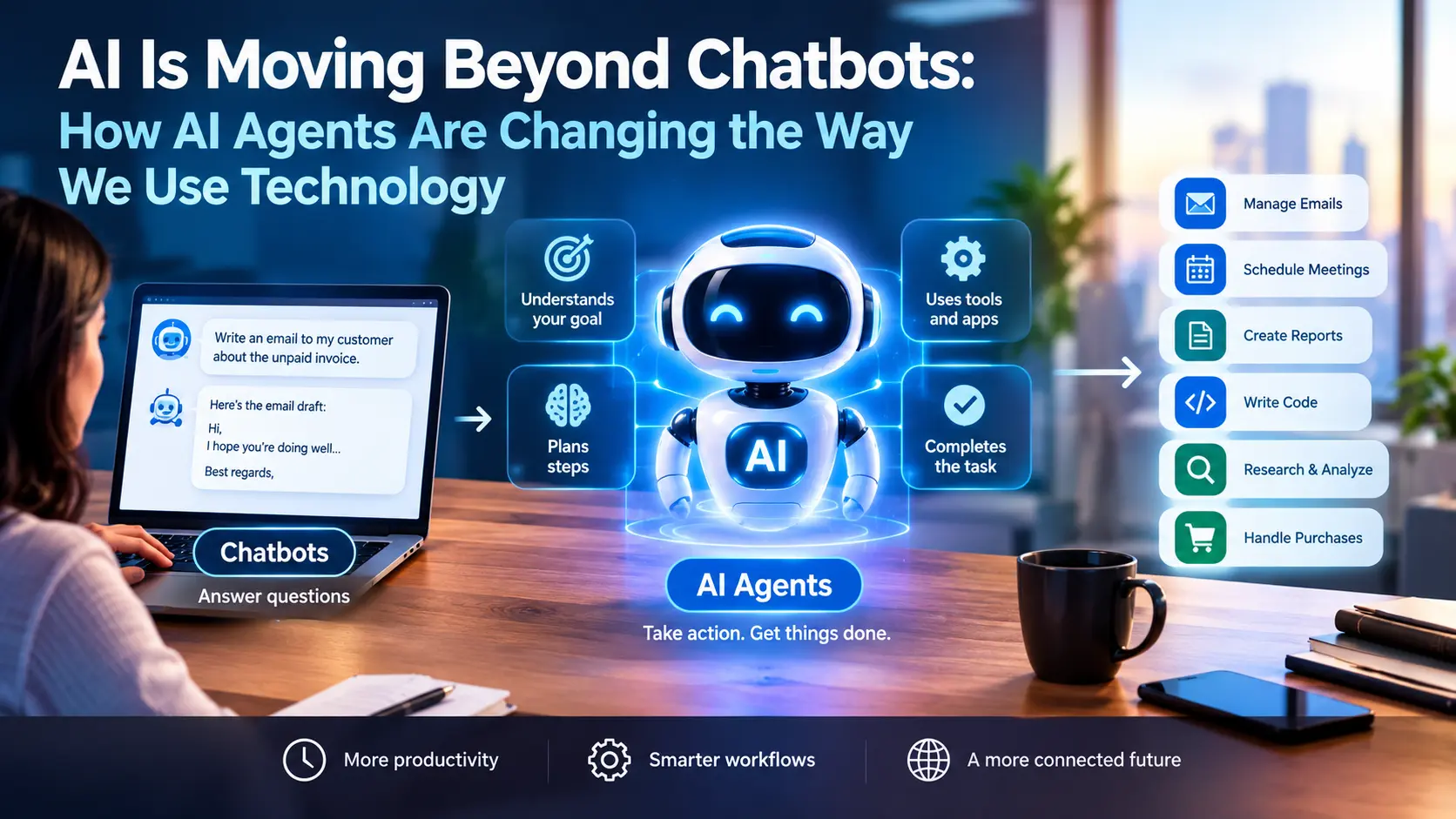
Artificial intelligence has changed dramatically over the past few years. What began for many consumers as a way to ask questions, generate text, or create images is increasingly becoming something more active: software that can perform tasks on a user’s behalf.
The latest phase of the AI race is increasingly focused on what the technology industry calls AI agents. Instead of simply responding to a question, an AI agent can be designed to understand a goal, break that goal into multiple steps, use software tools, and continue working until a task has been completed.
That shift could change how people interact with computers.
Microsoft, Google, OpenAI, Anthropic, and other technology companies are all developing products that move AI beyond simple question-and-answer interactions. Recent industry analysis from McKinsey identifies agentic software development, AI infrastructure, and model architectures among the technology areas attracting significant investment during 2026.
What Exactly Is an AI Agent?
A traditional chatbot waits for a user to provide a question and then generates an answer.
For example, someone might ask:
“Write an email asking my customer about an unpaid invoice.”
The AI generates the email, and the user takes the next step.
An AI agent is intended to go further.
A more advanced system might be given a goal such as:
“Find all unpaid invoices from this month, identify customers whose payments are overdue, prepare reminder emails and create a report.”
The system could potentially retrieve information, analyze it, create documents, and perform other actions through connected software.
The important difference is action.
Instead of simply producing information, an agent can potentially interact with applications and services.
That does not mean every AI agent can freely control a computer. The capabilities depend on the software, permissions, integrations, and security controls provided by its developers.
Nevertheless, the direction of development is clear: technology companies are trying to make AI systems more useful as digital assistants that can perform multi-step work.
Microsoft Is Expanding the Role of Copilot
Microsoft recently introduced a new Copilot experience designed around chat, coding, and autonomous task capabilities.
According to reporting from The Verge, Microsoft’s new Copilot application combines several functions into a unified experience, including a Home area, coding capabilities, and an Autopilot function intended to handle certain tasks autonomously.
The company is positioning Copilot as something more significant than a conventional chatbot.
For businesses, the potential use cases are extensive.
An employee might use AI to summarize meetings, analyze documents, monitor work channels, prepare reports or help create internal applications.
Developers could use AI systems to write and modify code.
Customer-support teams could use agents to organize requests and suggest responses.
Marketing departments could potentially automate portions of research and content workflows.
However, automation does not necessarily mean that humans disappear from the process.
Businesses still need people to define goals, review important decisions, and manage sensitive information.
Why AI Agents Matter for Small Businesses
Large corporations are not the only organizations that could benefit from agent-based software.
Small businesses may actually have some of the most practical use cases.
Consider a small online store.
A business owner may spend hours each week checking orders, answering common customer questions, updating spreadsheets, and monitoring product inventory.
An AI system connected to the appropriate tools could potentially assist with some of those repetitive activities.
For example, an agent could summarize new orders, identify products with low stock and prepare a list of customers requiring follow-up.
The business owner would remain responsible for decisions, but the amount of manual work could potentially be reduced.
For freelancers, AI agents could also assist with project organization, document preparation, research, and scheduling.
The technology therefore isn’t limited to people working in large technology companies.
AI Is Also Changing Software Development
Software development is another area where agentic AI is gaining attention.
Traditional coding assistants generally help developers write individual pieces of code.
Newer agent-based systems aim to handle larger portions of a development workflow.
A developer may describe a feature, and an AI system can potentially inspect a project, identify relevant files, suggest changes, create code, run tests, and help diagnose errors.
That can change the role of the developer.
Instead of manually writing every line, developers may increasingly spend more time describing requirements, reviewing generated code, and deciding how different components should work together.
This doesn’t eliminate the need for programming knowledge.
In fact, understanding architecture, security, testing and debugging may become even more important because generated code still needs human review.
The Rise of AI Infrastructure
Behind every AI assistant is a large technology infrastructure.
Powerful models require computing resources, data storage, networking and specialized chips.
The rapid expansion of AI has therefore created enormous demand for data-center infrastructure.
Microsoft said in September that it would begin reporting Azure cloud sales directly in its financial reporting, highlighting the growing importance of cloud computing as technology companies compete for AI-related workloads. Reuters reported that Microsoft, Amazon and Google are competing heavily in cloud computing amid the AI data-center boom.
This infrastructure race is less visible to ordinary consumers than a new smartphone or app, but it is fundamental to the AI industry.
Every time millions of users interact with an AI service, computing resources are required to process those requests.
As agents become capable of completing longer workflows, the amount of computing required could increase further.
AI Agents Also Create New Security Problems
The ability to take action creates an obvious security challenge.
A chatbot that gives an incorrect answer can be inconvenient.
An AI agent with access to email, financial information, or company software could potentially cause much greater damage if it makes a mistake or is manipulated.
This is why permissions are becoming extremely important.
An AI system should not automatically receive unlimited access to every application.
Organizations may need to determine exactly what an agent can read, what it can change, and which actions require human approval.
For example, an AI assistant might be allowed to prepare a payment request but not actually send money.
Similarly, it might draft an email but require a person to approve it before sending.
These controls can help reduce the consequences of mistakes.
Cybercriminals Are Using AI Too
AI isn’t only helping defenders.
Security researchers and companies are increasingly warning that attackers can also use artificial intelligence to make cyberattacks more efficient.
A recent report described phishing activity in which attackers impersonated AI experts and used AI-related themes to target people involved in artificial intelligence policy. The campaign involved deceptive messages that redirected targets toward credential-stealing websites.
The incident demonstrates an important problem.
AI does not need to invent a completely new type of cyberattack to be dangerous.
It can make existing techniques faster and easier to scale.
A convincing phishing message, for example, can potentially be generated in seconds.
This means consumers should become more cautious about unexpected messages, even when they appear professionally written.
Why Human Oversight Still Matters
AI agents may become increasingly capable, but they still operate within systems designed by people.
They can misunderstand instructions.
They can use incorrect information.
They can make assumptions.
They can encounter unusual situations that were not anticipated by their developers.
For high-impact decisions, human review therefore remains important.
A useful model for businesses is to divide tasks into levels.
Low-risk tasks could be automated.
Medium-risk tasks could require approval.
High-risk activities could remain entirely under human control.
For example, automatically organizing a calendar may be relatively low risk, while approving a major financial transaction should involve stronger safeguards.
AI Could Change the Traditional Computer Interface
For decades, people have interacted with computers primarily through applications.
If someone wants to send an email, they open an email application.
If they want to edit a document, they open a word processor.
If they want to create a spreadsheet, they open spreadsheet software.
AI agents could eventually provide a different interface.
Instead of thinking about which application to open, users may simply describe what they want to accomplish.
The AI could determine which tools are required.
This is one reason technology companies are investing heavily in agentic software.
The potential change is not simply another chatbot feature. It could represent a different way of interacting with digital services.
What Consumers Should Expect
Consumers should not expect every AI service to suddenly become fully autonomous.
The transition will likely happen gradually.
Some applications will add small agent-like features.
Others will allow AI to complete specific workflows.
More advanced systems will eventually combine multiple tools.
The biggest changes may happen first in workplaces, where businesses can control software environments and define specific tasks.
Consumer products may then adopt similar capabilities.
Smartphones, computers and web browsers could increasingly become interfaces through which users delegate tasks to AI.
The Bottom Line
Artificial intelligence is entering a new stage.
The focus is moving from systems that simply generate answers toward systems capable of completing multi-step tasks.
Microsoft’s latest Copilot developments illustrate this direction, while broader technology investment is increasingly focused on agentic software, AI infrastructure and related technologies.
The benefits could include less repetitive work, faster software development and easier access to complex digital tools.
But greater autonomy also brings greater responsibility.
Security, privacy, permissions and human oversight will become increasingly important as AI systems receive access to more information and software.
The next generation of computing may therefore not be defined simply by how intelligent an AI model is.
It may be defined by what that AI is actually allowed to do.
For consumers and businesses, understanding that distinction will become increasingly important as AI moves from answering questions to taking actions.