
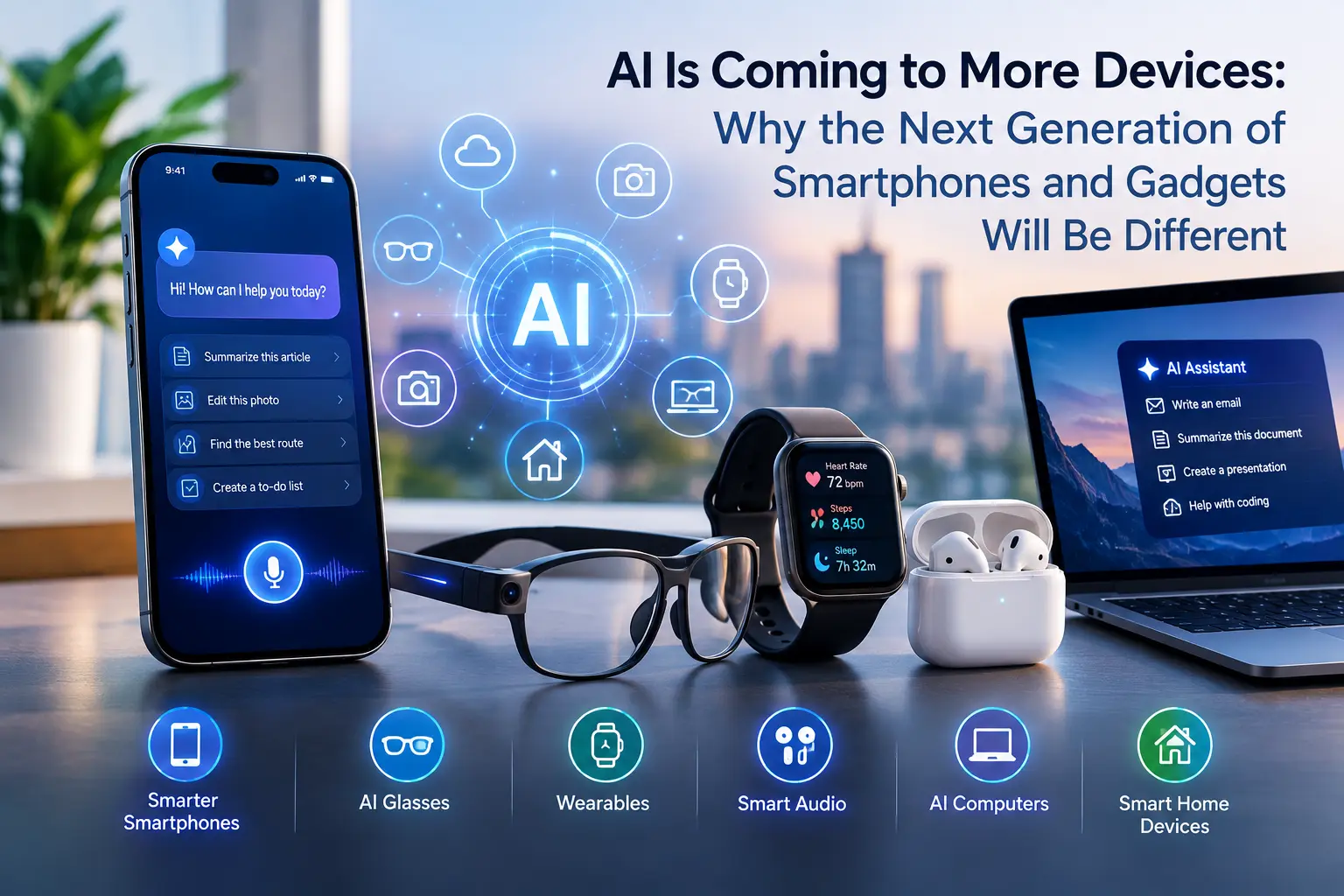
Artificial intelligence is no longer limited to websites and chat applications.
In 2026, AI has increasingly become part of everyday consumer technology, including smartphones, smart glasses, wearable devices, computers, and other connected products.
The change is happening gradually.
Instead of treating AI as a separate application that users have to open, technology companies are increasingly integrating AI directly into devices.
This could eventually change how people search for information, communicate, create content, and control their gadgets.
Recent technology developments provide several examples of this shift. India’s technology news cycle has included new AI features for smartphones and wearables, while companies are also experimenting with new categories of AI-powered hardware.
Smartphones Are Becoming AI Devices
The smartphone has already become one of the most powerful personal computers most people carry.
Modern phones can edit photographs, translate conversations, summarize information, recognize objects, generate text, and perform increasingly sophisticated computational tasks.
AI is becoming a larger part of those capabilities.
Instead of relying entirely on traditional software menus, users can increasingly describe what they want in natural language.
For example, someone might ask their phone to summarize a long message, remove unwanted objects from a photograph, or organize information from several documents.
The advantage is convenience.
Users do not necessarily need to understand which individual application contains the required feature.
AI Can Make Cameras More Intelligent
Smartphone cameras are another area where AI is already changing the experience.
Modern computational photography systems analyze images and make adjustments automatically.
AI can help identify scenes, improve exposure, reduce noise, and process photographs after they are captured.
The future could take this further.
Rather than simply improving image quality, AI could help users decide what to photograph, organize large photo libraries, or create edited versions of images based on natural-language instructions.
This could be particularly useful for content creators.
A person recording a short video may be able to use AI to identify the strongest moments, create captions, remove background noise, and prepare multiple versions for different social-media platforms.
AI Is Moving Into Wearable Technology
Another major development is integrating AI into wearable devices.
Smart glasses are one example.
Meta has continued expanding its hardware efforts, and the company recently introduced a small AI-focused handheld device called Meta Charm. Reuters reported that the device is designed to work with Meta’s Muse AI assistant and includes a small touchscreen and 5G connectivity.
The significance of such products goes beyond one particular device.
Technology companies are exploring whether users want AI available without constantly looking at a traditional smartphone.
That could lead to a wider range of AI-enabled devices.
Why AI Glasses Are Interesting
Smart glasses have existed for years, but previous products struggled to become mainstream.
AI may give the category a different reason to exist.
Imagine wearing glasses that can provide information about what you are looking at, translate signs, help with navigation, or allow you to communicate without taking your phone out of your pocket.
These capabilities are still subject to technical and privacy limitations.
Battery life remains important.
Processing power is limited by the size of wearable hardware.
Connectivity is also necessary for many cloud-based AI functions.
Nevertheless, AI gives smart glasses a potentially more useful role than simply displaying notifications.
Privacy Is Becoming a Bigger Issue
The expansion of AI hardware also creates serious privacy questions.
A device equipped with microphones, cameras, or sensors may collect information about the person using it as well as people nearby.
This becomes especially important with smart glasses.
A person wearing a camera-equipped device could potentially record others without them realizing it.
Technology companies therefore face a difficult challenge.
They need to make AI devices useful while also making their operation understandable to surrounding people.
Clear recording indicators, privacy controls, and responsible data practices may become increasingly important as wearable AI becomes more common.
AI Is Also Appearing in Fitness Technology
Wearable technology is another major area of AI development.
Fitness trackers and smartwatches already collect information such as movement, heart rate, and sleep-related measurements.
AI can analyze patterns in that data and turn raw measurements into summaries.
The technology can potentially help users understand changes in their activity or exercise habits.
However, consumers should remember that consumer wearables are not automatically medical devices.
Health-related information from a smartwatch or fitness tracker should not be treated as a medical diagnosis.
If a device reports something concerning, professional medical advice may be appropriate.
The Screen-Free Device Trend
One interesting development is the idea that AI devices do not necessarily need large screens.
Traditional computing has always revolved around displays.
Computers have monitors.
Smartphones have large touchscreens.
Tablets have displays.
But voice-based AI and wearable technology make it possible to imagine devices that require less visual interaction.
A small device could potentially listen to a request and provide an audio response.
This may be useful while walking, driving, or working.
However, screen-free computing also introduces challenges.
Users need to know what the device is doing.
They may need visual controls for sensitive operations.
And voice interactions are not always suitable for private situations.
AI Is Changing Computers Too
The AI hardware trend is not limited to phones.
Laptops and desktop computers are increasingly being designed around AI capabilities.
Some newer computers include dedicated hardware intended to accelerate AI workloads locally.
Local AI processing can have several advantages.
It may reduce the need to send certain information to remote servers.
It can potentially reduce latency.
And some functions may continue working when the internet connection is limited.
However, cloud-based AI remains important because large models often require much more computing power than a consumer device can provide.
The likely future is therefore a combination of local and cloud processing.
Local AI Versus Cloud AI
Imagine a smartphone receiving a simple request such as:
“Make this photo brighter.”
That type of operation could potentially be processed directly on the device.
A more complex request might require a powerful cloud model.
The division between local and cloud AI will depend on factors such as model size, hardware capabilities, privacy requirements, and network connectivity.
For consumers, the distinction may become invisible.
The device may simply choose the appropriate method automatically.
AI Could Change How We Search
Search is another area likely to experience significant change.
Traditional search engines generally provide a list of webpages.
AI systems can instead provide a direct conversational response.
Google has been expanding AI-related search capabilities, while technology companies are also experimenting with ways for AI assistants to perform actions.
Recent reporting from India indicated that Google was testing shopping-related functionality within Gemini and AI Mode, illustrating how AI assistants may increasingly connect information discovery with commercial actions.
This could eventually make search more conversational.
Instead of searching separately for information, comparing products, and visiting several websites, a user may describe the complete task.
For example:
“Find a laptop under my budget with good battery life and compare the available options.”
The AI could potentially gather information and organize it.
Users would still need to verify important details before making purchasing decisions.
AI and Consumer Electronics
The AI trend is also reaching headphones, televisions, home appliances and other consumer products.
Manufacturers are adding AI features to products that previously had relatively simple functions.
For example, headphones may use AI for voice processing.
Televisions may provide AI-assisted picture or audio processing.
Home devices can increasingly respond to natural-language commands.
This creates a larger technology ecosystem in which different devices understand similar AI interfaces.
The Risk of Adding AI Everywhere
Not every product necessarily needs AI.
Technology companies may sometimes use the term because it attracts consumer attention.
A useful AI feature should solve a real problem rather than simply add another button or marketing label.
Consumers should therefore ask practical questions.
Does the AI feature save time?
Does it work reliably?
Does it require a subscription?
What information does it collect?
Can the feature work without an internet connection?
Can users turn it off?
These questions can help separate genuinely useful features from technology marketing.
Security Will Become More Important
As AI devices gain access to microphones, cameras, personal files, and online accounts, security becomes increasingly important.
A compromised AI assistant could potentially expose sensitive information.
The risk becomes greater when devices can take actions automatically.
For this reason, users should keep device software updated, use strong authentication, and carefully review application permissions.
Businesses should also implement stronger access controls when AI tools are connected to company systems.
What the Next Few Years Could Look Like
The most likely future is not one single AI device replacing everything.
Instead, AI will probably become a layer that exists across many devices.
Your phone may provide one AI interface.
Your computer may provide another.
Your glasses could provide hands-free interaction.
Your smartwatch could monitor activity.
Your home devices could respond to voice commands.
The important change is that these devices may increasingly understand context.
Instead of treating every request as an isolated command, AI systems could potentially use information from several connected services to provide more useful assistance.
That possibility also makes privacy and data control more important.
Consumers Will Have More Choices
As more companies enter the AI hardware market, consumers are likely to see more products competing for attention.
Some will focus on smartphones.
Others will concentrate on wearables.
Some companies will emphasize privacy.
Others may focus primarily on powerful cloud AI.
Competition can produce rapid innovation, but it can also make buying decisions more complicated.
Consumers should therefore look beyond specifications.
Battery life, software support, privacy controls, repairability, subscription costs and long-term updates can be just as important as an AI processor or camera specification.
The Bottom Line
AI is increasingly becoming a built-in part of consumer technology rather than a standalone application.
Smartphones, computers, wearables, and emerging AI gadgets are all being developed around the idea that users should be able to interact with technology more naturally.
Recent developments from companies including Meta and Google demonstrate how quickly this category is evolving. Meta’s new AI-focused hardware and the expansion of AI functionality across Google’s ecosystem are examples of a much broader industry movement.
The biggest change may ultimately be less about individual devices and more about how people interact with technology.
Instead of opening an application and manually completing every step, users may increasingly describe what they want and allow AI to help complete the task.
That future offers convenience, but it also requires careful attention to privacy, security and accuracy.
AI hardware is still developing, and many of today’s experiments will undoubtedly change over time.
For consumers, the most useful approach is to focus on what a device actually does, how reliably it works and what happens to the information it collects—not simply whether the product carries an “AI” label.